What is Contextual Inquiry?
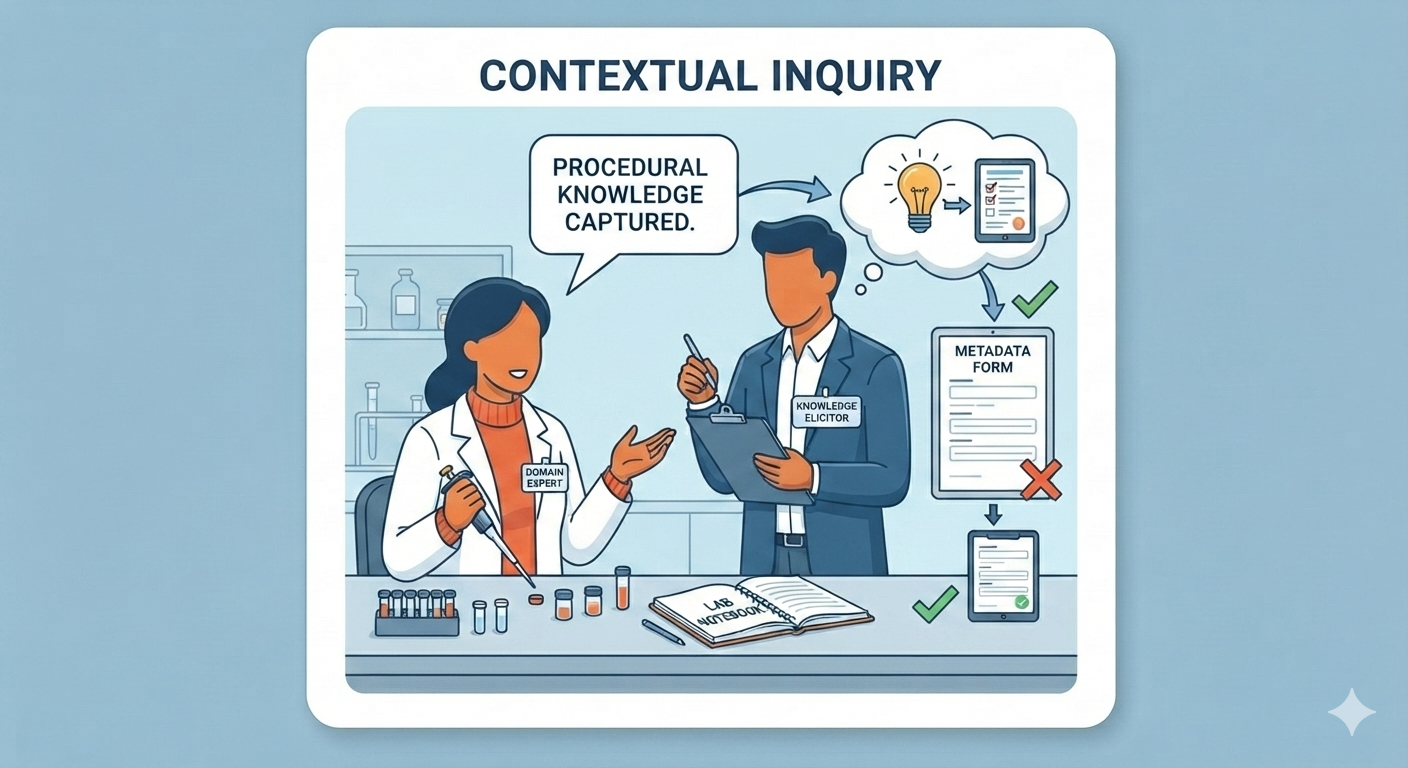
Contextual inquiry (CI) is a qualitative research method used to understand how users perform tasks in their actual work environments. Unlike “Teachback,” where the expert explicitly adopts a teacher role to instruct the elicitor, in contextual inquiry, the expert simply performs their regular work. The elicitor observes these actions and asks questions as they arise. This approach allows the researcher to capture not only what people say they do, but what they actually do, including the tools they use, their social interactions, and the environmental constraints that shape their behavior.
When to use Contextual Inquiry?
- To understand real-world workflows and “tacit” knowledge that users might forget to mention in a traditional interview.
- When designing new products, tools, or digital systems to replace manual or cumbersome processes (e.g., replacing long metadata forms with automated data capture).
- When the physical environment, specific tools, or social interactions are critical to the task being performed.
- In user-centered design to ensure product strategy is grounded in actual user behavior rather than assumptions.
- When looking to consolidate procedural knowledge from highly specialized or hands-on environments (e.g., laboratory experiments).
Required roles and materials
- Roles:
- Knowledge elicitor: Acts as a facilitator and observer.
- Domain expert: The person performing the task (e.g., the lab experiment executors).
- Documenter: A person responsible for recording the process (may be one of the domain experts).
- Materials:
- Source of information: Existing physical records (e.g., paper lab notebooks).
- Interview Guide: A structured set of prompts to guide the inquiry.
- Target Schema: The objectives or structure of the original documentation/form being replaced.
- Recording materials: Tools for audio or video recording the session.
Procedure
- Planning and preparation: Define the specific research goals and identify the target users. Develop a tailored interview guide.
- Contextual observation: Observe users while they work in their natural environment. Take detailed notes on the tools used, specific actions taken, and social interactions occurring.
- Engagement and interviewing: Ask open-ended questions regarding the user’s actions, their thought processes, decision-making logic, and the challenges they face.
- Documentation and analysis: Review observation notes to identify recurring patterns, themes, and critical procedural steps.
- Iterative refinement: Use findings to refine design concepts or prototypes. Test these improvements with users and repeat the process as necessary to ensure accuracy.
References
- Whiteside, J., Bennett, J., and Holtzblatt, K. (1988). “Usability Engineering: Our Experience and Evolution.” In Handbook of Human Computer Interaction, M. Helander (Ed.). New York: North Holland.
- Wixon, D., Holtzblatt, K., and Knox, S. (1990). “Contextual Design: An Emergent View of System Design.” Proceedings of CHI ’90. Seattle, WA.
- Beyer, H. and Holtzblatt, K. (1995). “Apprenticing with the Customer.” Communications of the ACM, May.
- Beyer, H. and Holtzblatt, K. (1997). Contextual Design: Defining Customer-Centered Systems. Morgan Kaufmann Publishers Inc., San Francisco.
- Privitera, Mary Beth. (2015). Contextual Inquiry for Medical Device Design. Academic Press. (Chapter 1: Introduction to Contextual Inquiry).