What is Critical Incident Strategy (CIS)?
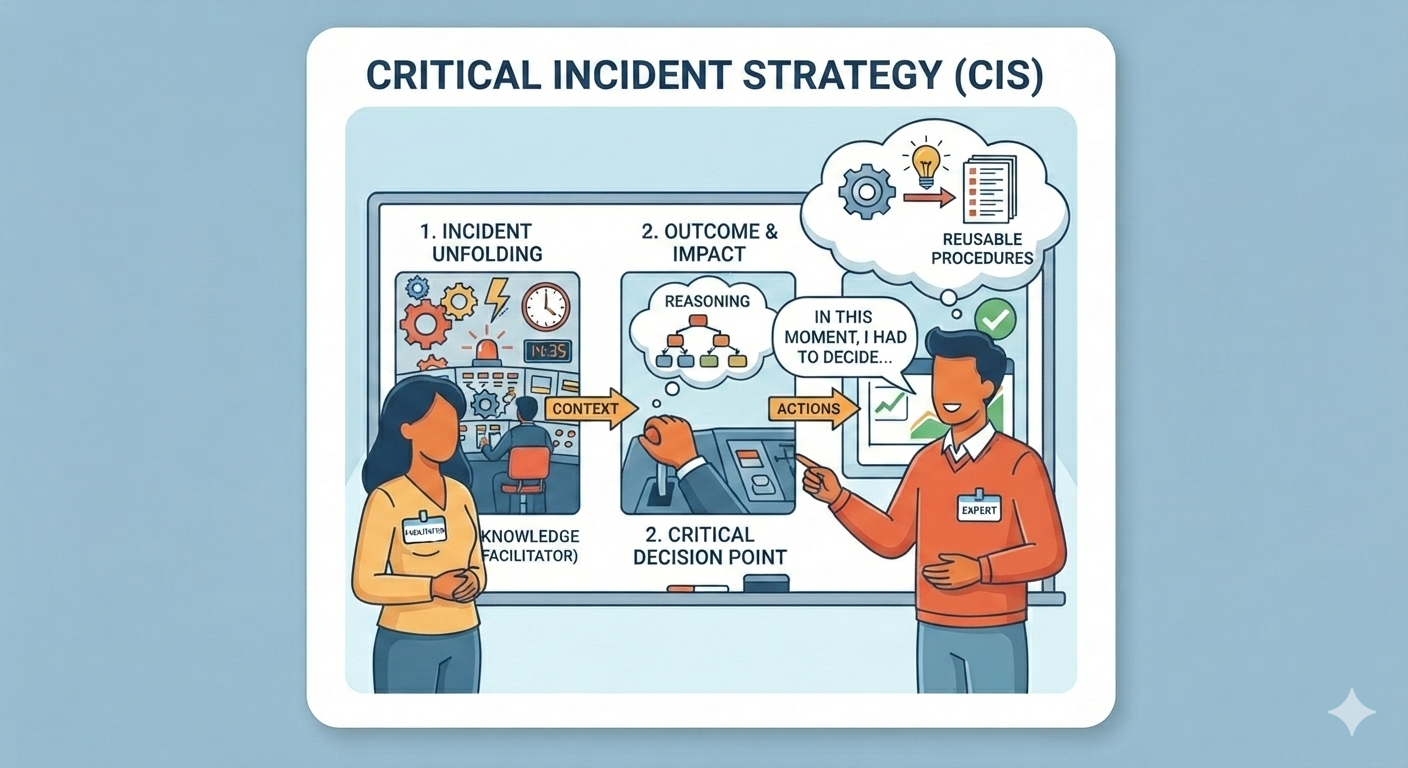
The critical incident strategy (CIS) is a method designed to extract deep, expert knowledge by focusing on specific, high-impact events rather than general procedures. By asking experts to recount significant successful, problematic, or unusual situations, the technique moves beyond abstract descriptions of “what usually happens.” This focus allows the elicitor to uncover tacit knowledge, specific decision criteria, complex reasoning processes, and the practical expertise that experts use to navigate real-world challenges which are elements that are often difficult to express through standard, generalized interviews.
When to use Critical Incident Strategy?
- When general interviews fail to capture the nuances of how experts actually make decisions.
- When trying to uncover “tacit knowledge” (skills or insights that are difficult to articulate in the abstract).
- When looking to identify specific decision criteria, cues, or heuristics used in high-stakes or unusual situations.
- When the goal is to understand the causes of success or failure in complex tasks.
- When developing reusable guidelines, decision-support tools, or knowledge models based on proven real-world experiences.
Required roles and materials
- Roles:
- Domain expert: The individual who experienced the incident and possesses the relevant expertise.
- Knowledge elicitor: The interviewer/analyst responsible for guiding the recount and probing the reasoning.
- Materials:
- Interview guide: Prompts designed to help the expert move from description to reasoning.
- Recording tools: Audio or video recording equipment to capture detailed accounts.
- Note-taking materials: To document key factors, cues, and emerging patterns.
Procedure
- Identify a critical incident: Ask the expert to recall and select a significant event that required important decisions or actions and had a notable impact.
- Describe the incident: Collect a detailed, chronological account of the context, the specific actions performed, and the eventual outcomes achieved.
- Explore the reasoning: Probe deeper into the “why” behind the expert’s actions, investigating the specific logic used and the information that influenced their decisions.
- Identify key factors: Analyze the account to pinpoint critical cues, success factors, constraints, and specific decision strategies employed during the incident.
- Generalize the knowledge: Transform the specific findings from the incident into reusable procedures, decision guidelines, or broader knowledge models.
References
(No references provided)