What is Information Flow Methodology (IFM)?
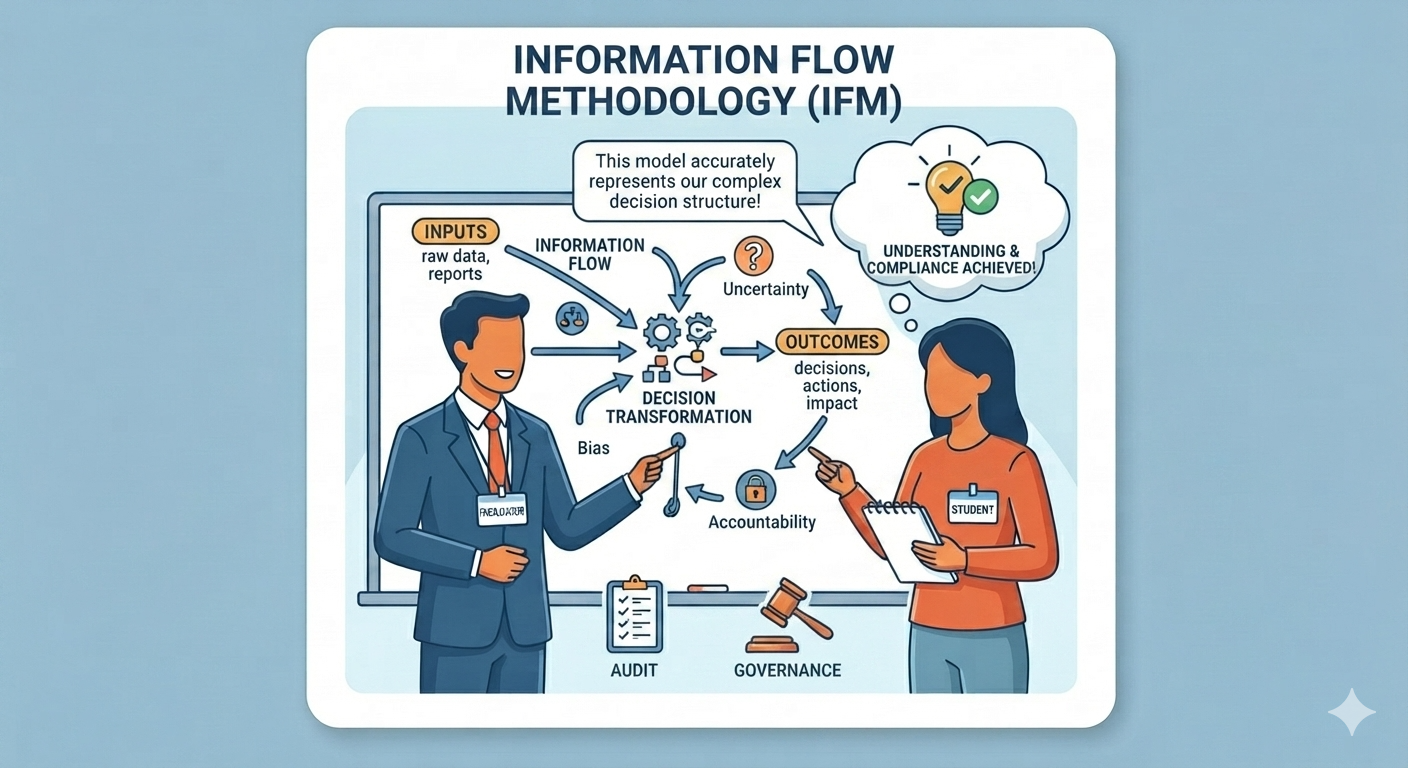
The Information Flow Methodology (IFM) is a structured way to describe and analyze how decisions are made in socio-technical systems. It models a decision as a transformation of information—showing where information comes from, how it is interpreted or processed, and how it leads to an outcome. Unlike traditional process maps (like BPMN or UML) that focus on activities or control flows, IFM emphasizes the dependencies between information to reveal how decisions are formed, what they rely on, and where responsibility or uncertainty resides. It provides a holistic view of the decision process, helping to avoid framing traps common in isolated component-level evaluations.
When to use Information Flow Methodology?
- When analyzing decision-making structures in socio-technical systems.
- To support AI transparency, accountability, and governance.
- When assessing bias, fairness, and impact in automated or human-AI hybrid systems.
- For regulatory compliance assessments (e.g., EU AI Act) and AI procurement.
- In settings where decisions emerge from multiple roles, systems, or layers of information.
- As a modular approach that can be combined with other methods, such as “think aloud.”
Required roles and materials
- Roles:
- Stakeholders: The people who develop, perform, or oversee parts of the decision process (involved via participatory modeling).
- Decision-makers/Operators: Individuals or automated systems that transform information.
- Auditors/Assessors: Those using the model for impact assessments or compliance.
- Materials:
- Modeling tools for sketching and refining information flows.
- Documentation of information inputs, transformations, and outcomes.
- Complementary modeling tools (if temporal order or detailed task execution needs to be captured).
Procedure
- Sketching the Information Flow: Create an initial visual representation of how information moves through the system.
- Refining the Information Flow Model: Iteratively improve the model to accurately reflect the decision-making process.
- Assigning Types and Semantic Roles: Define the specific nature of the information and the roles it plays in the transformations.
- Identifying and Mapping Biases: Pinpoint where information transformations might introduce or propagate bias.
- Connecting Stakeholders and Impact: Link the information flow to the people involved and the resulting impacts on them.
- Evaluating Mitigation and Design Options: Analyze the model to propose improvements, design changes, or risk mitigation strategies.
References
- Information Flow Model (IFM) – Methodological Guide (v0.6 Validation Version), https://doi.org/10.5281/zenodo.17808690