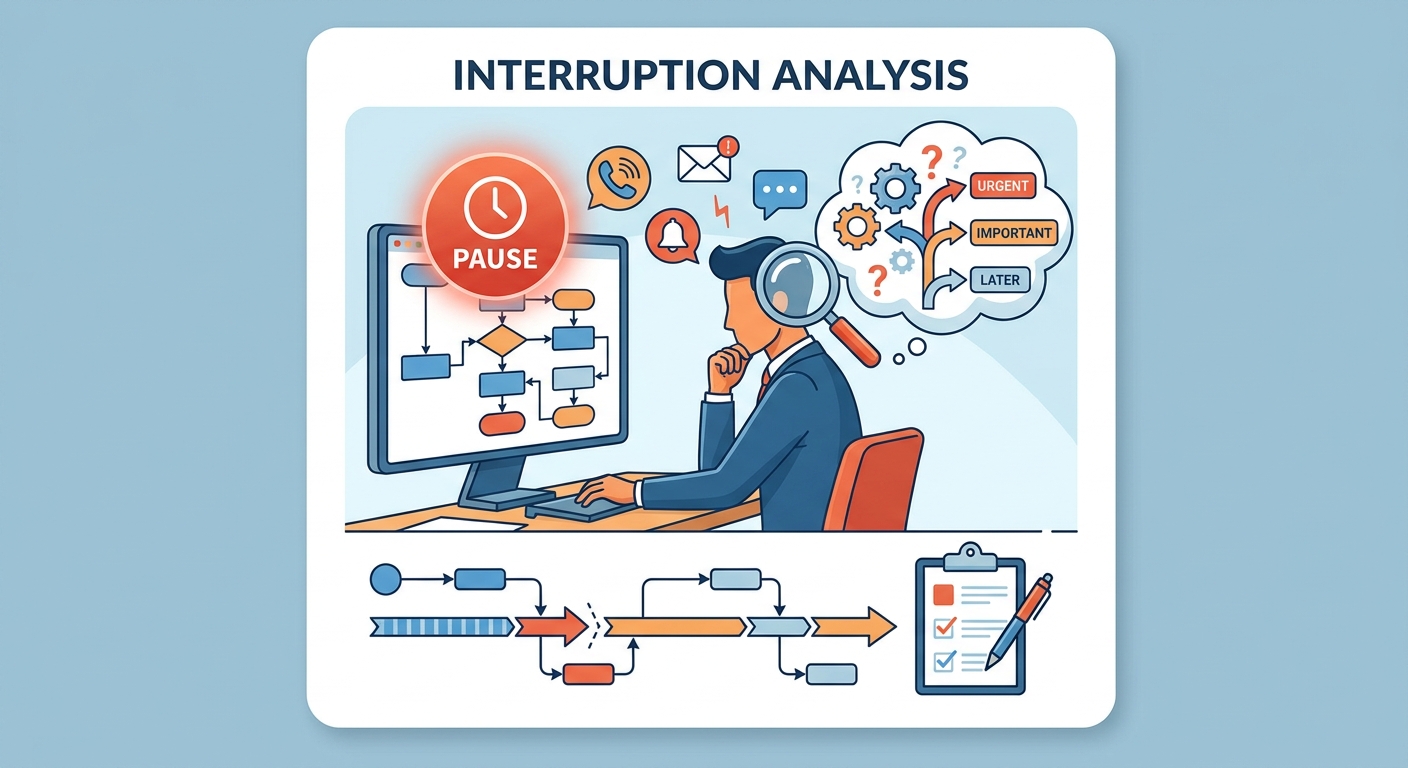
What is Interruption Analysis?
Interruption analysis is a knowledge elicitation technique in which an expert’s task performance is deliberately interrupted or observed during naturally occurring interruptions to study how they resume work, shift attention, and manage competing demands. The way experts handle interruptions reveals underlying cognitive processes, priorities, and strategies that are often not explicitly articulated.
When to use Interruption Analysis?
- When tasks involve multitasking or frequent interruptions
- In dynamic, real-time environments (e.g., healthcare, control rooms)
- When understanding attention management and task-switching strategies
- To uncover implicit prioritization and recovery behaviors
- When studying resilience and error management in complex workflows
Required roles and materials
- Roles:
- Domain expert (task performer)
- Knowledge elicitor (observer/facilitator)
- Materials:
- Realistic task environment or simulation
- Recording tools (audio/video, screen capture)
- Interruption scenarios (planned or naturally occurring)
- Note-taking materials
Procedure
- Select the task: Identify a task that realistically involves interruptions or multitasking.
- Prepare interruptions: Either observe natural interruptions or design controlled ones relevant to the domain.
- Brief the expert: Explain the task and inform them that interruptions may occur.
- Conduct the session: Have the expert perform the task while interruptions are introduced or observed.
- Observe responses: Record how the expert pauses, switches tasks, prioritizes, and resumes work.
- Capture recovery strategies: Note cues, memory aids, or procedures used to return to the original task.
- Debrief: Ask the expert to explain their decisions, priorities, and coping strategies.
- Analyze findings: Identify patterns in attention management, prioritization, and error avoidance.
References
- Cooke, Nancy J. (1994). Varieties of knowledge elicitation techniques. International Journal of Human-Computer Studies, 41(6), 801–849.