What is Joint Interactive Modeling with (c)DMN?
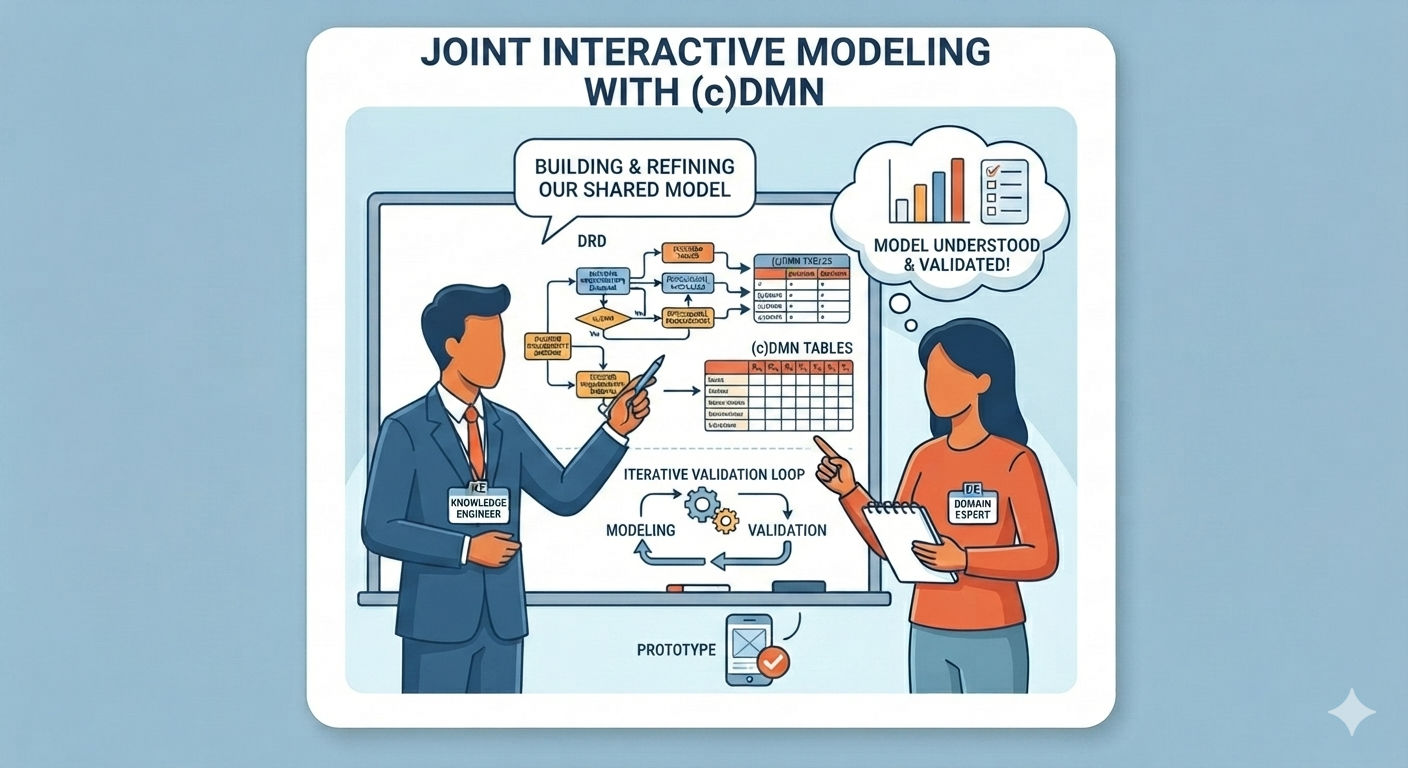
This technique is a collaborative approach to knowledge engineering. In this method, a Knowledge Engineer (KE) and one or more Domain Experts (DE) work in tandem to build a jointly understood domain model. The process leverages (c)DMN (Decision Model and Notation, potentially extended with constraint reasoning) to formalize decision logic. Rather than a one-way transfer of information, the method relies on an iterative cycle of modeling and validation using evolutionary prototypes to ensure the formal model accurately reflects the expert’s real-world decision-making logic.
When to use Joint Interactive Modeling with (c)DMN?
- When the domain experts involved possess strong abstract and analytical reasoning skills.
- When the domain knowledge is suitable for formalization using (c)DMN structures.
- When it is critical to establish a shared, unambiguous understanding of the domain between technical engineers and subject matter experts.
- When the goal is to move from high-level decision requirements to a validated, executable formal model.
Required roles and materials
- Roles:
- Domain Expert (DE): Provides the necessary specialized knowledge and decision logic (minimum of one required).
- Knowledge Engineer (KE): Leads the formalization of knowledge into the (c)DMN framework.
- Moderator (Optional): Manages the workshop, group dynamics, and the flow of the session.
- Materials:
- (c)DMN modeling tools.
- Tools for creating Decision Requirements Diagrams (DRDs).
- An environment for developing and running evolutionary prototypes for validation.
Procedure
- Workshop introduction: The moderator introduces the group members, defines the problem domain, and establishes the goals of the session.
- KE introduces (c)DMN: The Knowledge Engineer explains the (c)DMN methodology to the experts to ensure a shared understanding of the modeling notation.
- Scoping the domain: The team creates an initial outline of the Decision Requirements Diagram (DRD) to define the boundaries of the domain.
- Elicit decision structure (Optional): The team develops a full DRD to map out the complete landscape of decisions and their interdependencies.
- Iterative Modeling Loop: For each decision identified in the DRD, the following steps are performed:
- Model decision knowledge: The KE and DE collaboratively populate (c)DMN tables to capture the specific logic of the decision.
- Model validation: The modeled decision is tested using an evolutionary prototype to ensure it functions as intended and aligns with expert reasoning.
References
- Deryck, M., Vandevelde, S., & Vennekens, J. (2026). Revaluation of Human Experts in AI Systems with Joint Interactive Modelling. In Proceedings of eKNOW 2026 (pp. 1). IARIA.
- VANDEVELDE, S., AERTS, B., & VENNEKENS, J. (2023). Tackling the DM Challenges with cDMN: A Tight Integration of DMN and Constraint Reasoning. Theory and Practice of Logic Programming, 23(3), 535-558. doi:10.1017/S1471068421000491
- https://idp-z3.be/