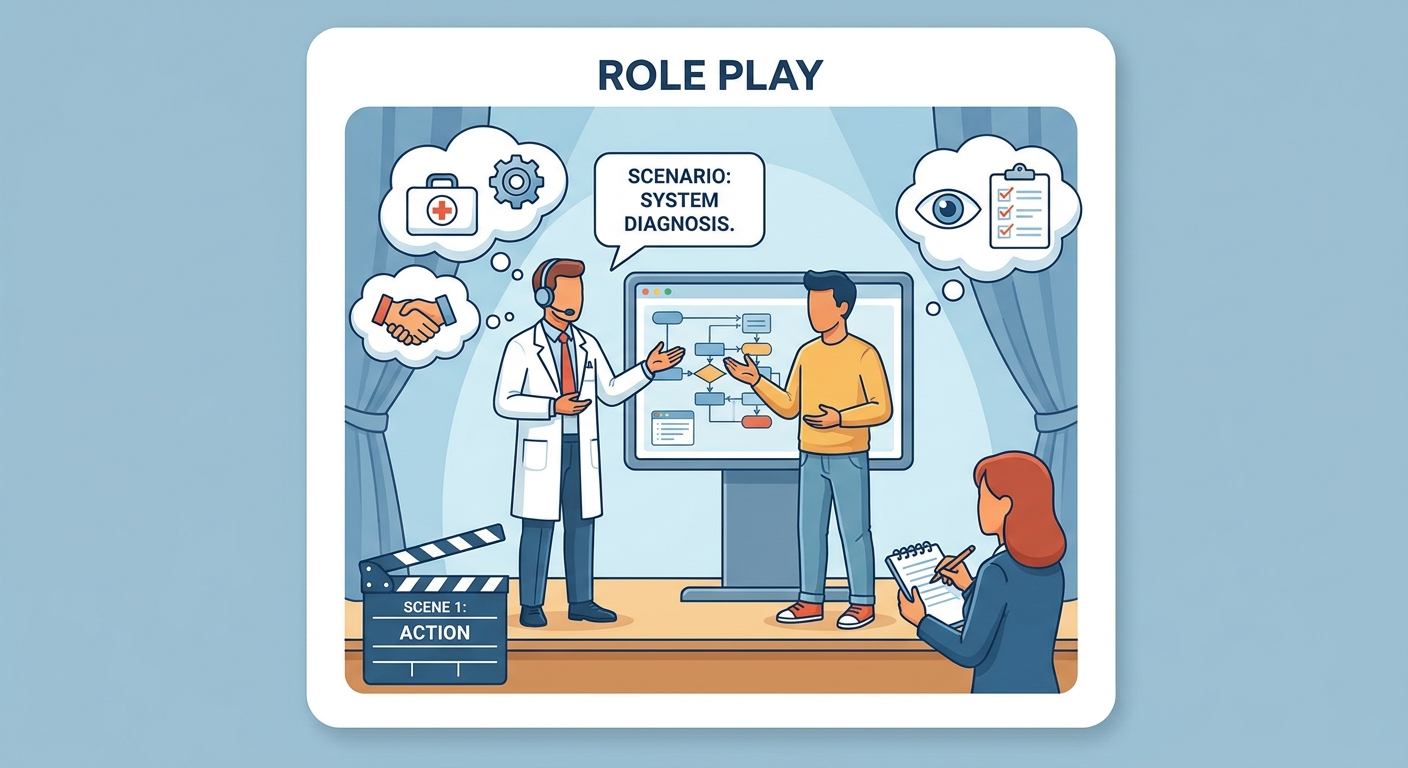
What is Role Play?
The role play technique is a knowledge elicitation method in which the expert enacts realistic scenarios by assuming specific roles (e.g., practitioner, client, system user). Through simulation of real-world interactions, the elicitor observes how the expert applies knowledge, makes decisions, and responds to dynamic situations.
When to use Role Play?
- When understanding interactive, social, or communication-based tasks
- For domains involving decision-making in context (e.g., diagnosis, negotiation)
- When knowledge is highly situational or tacit
- To explore rare, critical, or hard-to-observe scenarios
- When capturing behaviors that depend on role-specific perspectives
Required roles and materials
- Roles:
- Domain expert (playing one or more roles)
- Knowledge elicitor (observer and/or participant in a role)
- Materials:
- Scenario descriptions or scripts
- Recording tools (audio/video)
- Props or artifacts relevant to the domain (optional)
- Note-taking materials
Procedure
- Define the scenario: Select or design realistic situations relevant to the domain.
- Assign roles: Determine which roles participants will take (e.g., expert as practitioner, elicitor as client).
- Brief participants: Explain objectives and context, ensuring the expert understands the scenario.
- Enact the scenario: Conduct the role play, allowing the expert to respond naturally within their role.
- Observe and record: Capture decisions, interactions, and behaviors during the simulation.
- Pause or probe if needed: The elicitor may intervene to ask clarifying questions or explore alternatives.
- Debrief and reflect: Discuss actions taken, reasoning, and alternative strategies after the role play.
- Analyze results: Extract rules, strategies, communication patterns, and contextual factors from the interaction.
References
- Cooke, Nancy J. (1994). Varieties of knowledge elicitation techniques. International Journal of Human-Computer Studies, 41(6), 801–849.