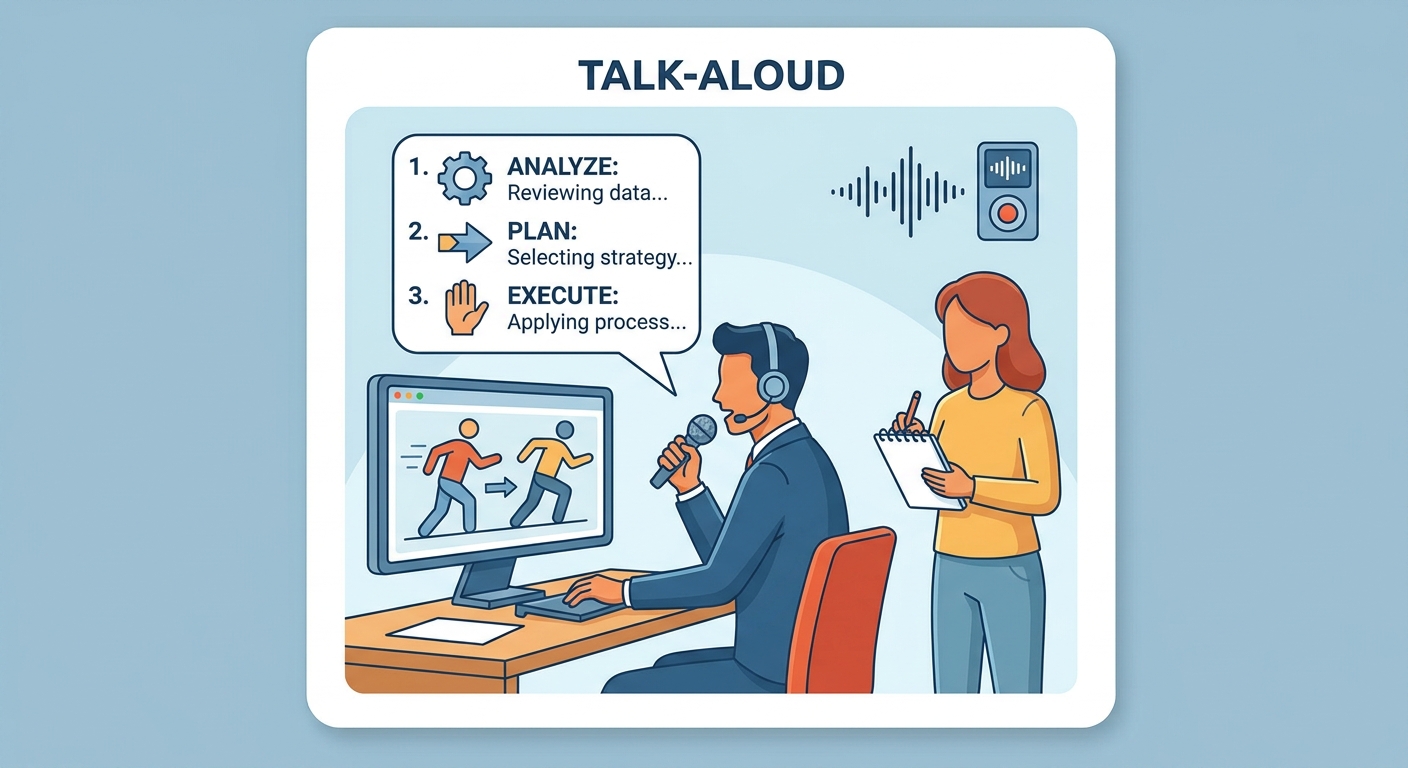
What is Talk-Aloud?
The talk-aloud technique is a knowledge elicitation method in which experts verbalize their reasoning, actions, and explanations while performing a task. Unlike think-aloud, which emphasizes raw, immediate thoughts, talk-aloud may involve more structured and explanatory narration of what the expert is doing and why.
When to use Talk-Aloud?
- When both actions and explanations of reasoning are important
- For tasks where experts can meaningfully explain their decisions while acting
- When a slightly more structured or interpretive verbalization is acceptable
- In training or instructional contexts where explanations are valuable
- When a balance is needed between natural cognition capture and clarity
Required roles and materials
- Roles:
- Knowledge elicitor (facilitator/observer)
- Domain expert (participant)
- Materials:
- Task scenarios or real-world tasks
- Recording equipment (audio/video)
- Note-taking tools
- Optional: screen capture or observational logs
Procedure
- Select the task: Choose a representative activity within the domain.
- Provide instructions: Ask the expert to describe what they are doing and explain their reasoning as they proceed.
- Perform the task: The expert carries out the task while verbalizing actions and decisions.
- Facilitate narration: The elicitor may prompt for clarification or elaboration if needed, more so than in think-aloud.
- Record data: Capture both the verbal explanations and the task execution.
- Follow-up questions: After the task, ask for deeper explanations or clarification of key steps.
- Analyze results: Extract decision rules, strategies, and explanatory knowledge from the verbalizations.
References
- Cooke, Nancy J. (1994). Varieties of knowledge elicitation techniques. International Journal of Human-Computer Studies, 41(6), 801–849.