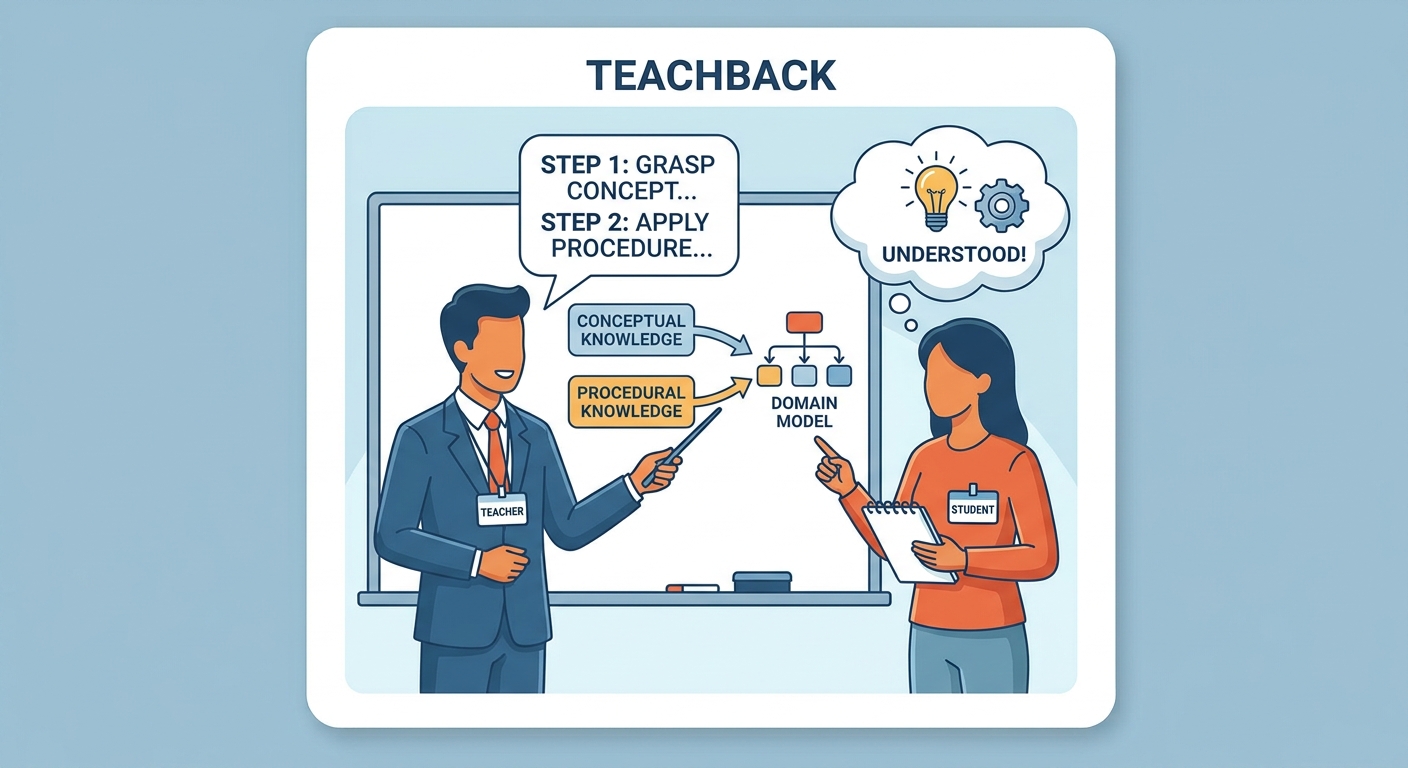
What is Teachback?
The teachback technique is a knowledge elicitation method in which the expert takes on the role of a teacher and instructs the elicitor (or another participant) on how to perform a task or understand a domain. By teaching, the expert externalizes both procedural and conceptual knowledge, often making implicit knowledge explicit.
When to use Teachback?
- When procedural or instructional knowledge needs to be captured
- When experts are comfortable explaining their work in a teaching context
- For domains involving skills, workflows, or step-by-step processes
- When uncovering both “how” (procedural) and “why” (conceptual) knowledge
- In later stages of elicitation to refine and validate previously gathered knowledge
Required roles and materials
- Roles:
- Domain expert (acting as instructor)
- Knowledge elicitor (learner/observer)
- Materials:
- Task environment or demonstration setup
- Recording tools (audio/video)
- Note-taking materials
- Optional: instructional aids (e.g., diagrams, examples, tools used in the task)
Procedure
- Define the learning objective: Identify the task or knowledge area the expert will teach.
- Assign teaching role: Ask the expert to instruct the elicitor as if they were training a novice.
- Demonstrate and explain: The expert performs the task while explaining each step, including rationale and decision points.
- Encourage interaction: The elicitor asks questions to clarify understanding and probe deeper into reasoning.
- Capture instructional structure: Record how the expert organizes and sequences information.
- Practice and feedback: The elicitor may attempt the task, allowing the expert to provide corrections and further explanations.
- Analyze knowledge: Extract procedures, rules, heuristics, and conceptual explanations from the teaching session.
References
- Cooke, Nancy J. (1994). Varieties of knowledge elicitation techniques. International Journal of Human-Computer Studies, 41(6), 801–849.