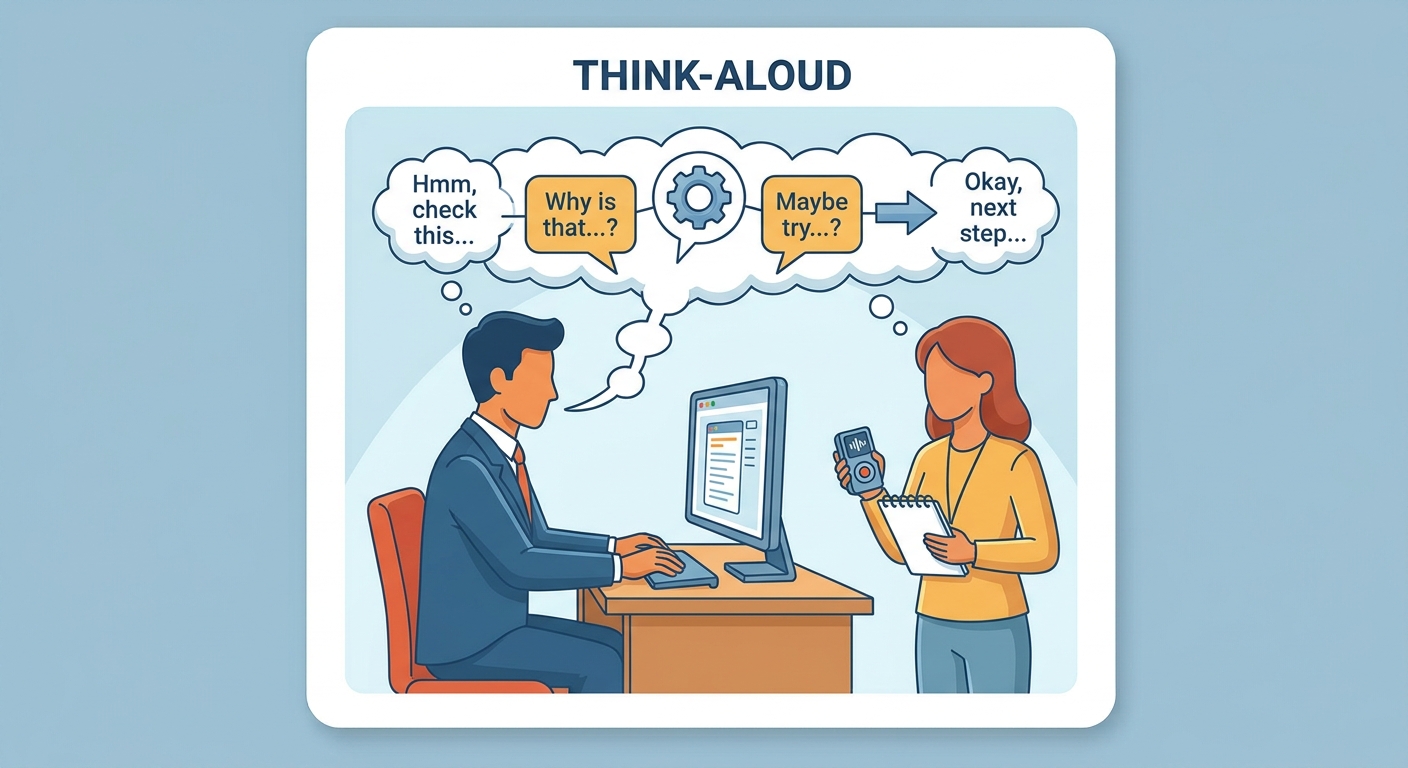
What is Think-Aloud?
The think-aloud technique is a knowledge elicitation method in which experts are asked to continuously verbalize their thoughts, reasoning, and decision-making processes while performing a task. This allows the elicitor to capture cognitive processes that are otherwise implicit or difficult to access.
When to use Think-Aloud?
- When the goal is to understand problem-solving and reasoning processes
- For complex or cognitive tasks where decisions are made step-by-step
- When capturing procedural or task-based knowledge
- In usability studies or human-computer interaction evaluations
- When experts can reasonably verbalize their thoughts without disrupting performance significantly
Required roles and materials
- Roles:
- Knowledge elicitor (observer/facilitator)
- Domain expert (participant performing the task)
- Materials:
- Task scenarios or real work tasks
- Recording equipment (audio/video)
- Note-taking tools
- Optional: screen recording software (for digital tasks)
Procedure
- Define the task: Select a representative task within the domain.
- Brief the expert: Instruct the expert to verbalize all thoughts while performing the task, without filtering or explaining after the fact.
- Conduct the session: Have the expert perform the task while continuously thinking aloud.
- Minimize interference: The elicitor remains mostly passive, only prompting the expert to continue speaking if they fall silent.
- Record observations: Capture both verbalizations and task actions.
- Clarify if needed: After completion, ask follow-up questions to resolve ambiguities.
- Analyze data: Extract reasoning steps, decision rules, and problem-solving strategies from the verbalized data.
References
- Cooke, Nancy J. (1994). Varieties of knowledge elicitation techniques. International Journal of Human-Computer Studies, 41(6), 801–849.