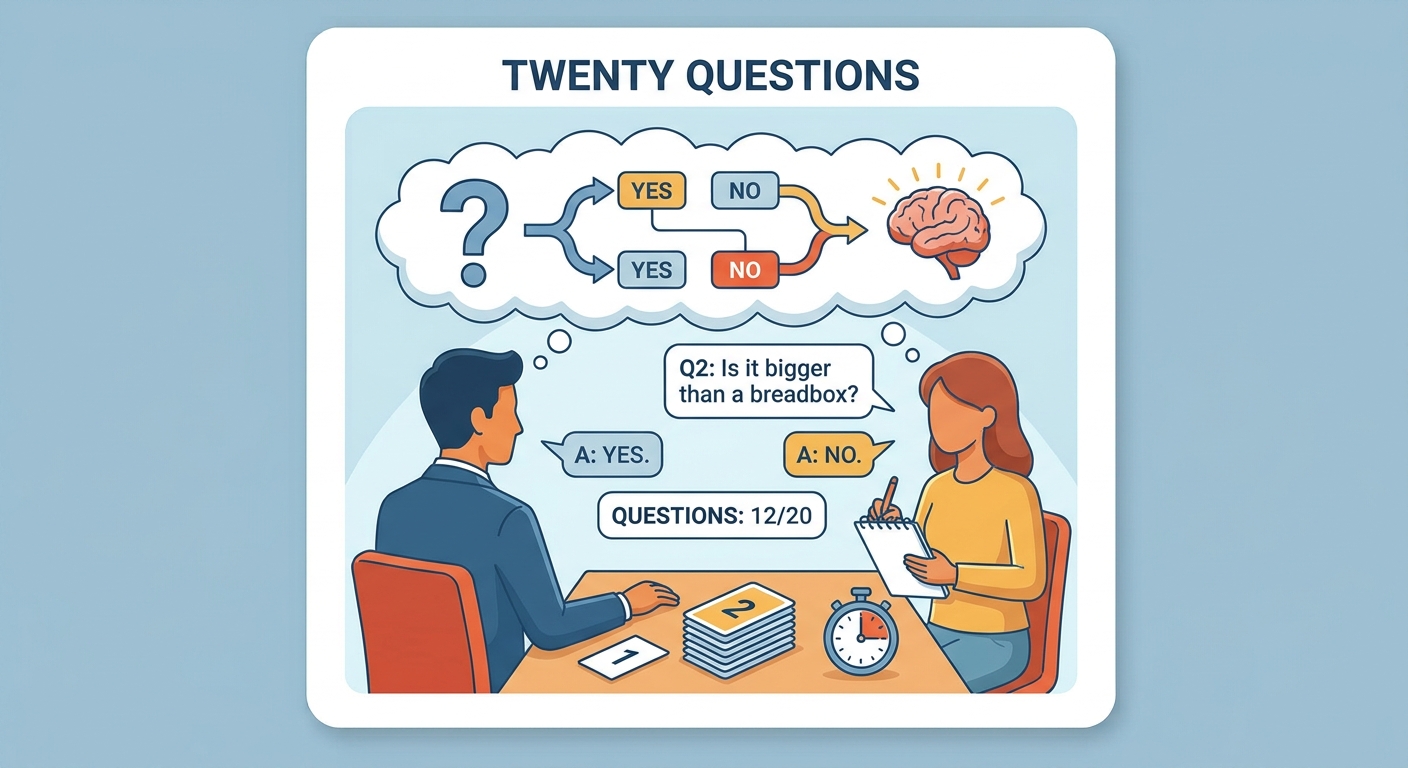
What is Twenty Questions?
The twenty questions technique is a knowledge elicitation method inspired by the guessing game, where the elicitor asks a series of constrained (typically yes/no) questions to identify concepts, distinctions, and decision criteria used by an expert. It is used to uncover how experts discriminate between items or situations by progressively refining hypotheses.
When to use Twenty Questions?
- When the goal is to understand classification or discrimination knowledge
- When expert knowledge is tacit and difficult to articulate directly
- In early stages of knowledge acquisition to explore a domain’s structure
- When comparing how experts distinguish between similar cases or concepts
Required roles and materials
- Roles:
- Knowledge elicitor (analyst/interviewer)
- Domain expert
- Materials:
- Recording tools (notes, audio, or video)
- Optional: predefined list of candidate items or concepts
- Question tracking sheet or decision tree template
Procedure
- Define the target domain: Select the set of objects, cases, or concepts to be identified or distinguished.
- Explain the task: Ask the expert to think of an item (or use a predefined one) while the elicitor attempts to identify it.
- Ask constrained questions: The elicitor asks a sequence of yes/no questions to narrow down possibilities.
- Track decision paths: Record each question and the expert’s response to capture the reasoning structure.
- Refine hypotheses: Use previous answers to formulate increasingly specific questions.
- Identify decision criteria: Analyze the sequence of questions to extract key distinguishing features and rules.
- Generalize knowledge: Convert the elicited distinctions into a structured representation (e.g., decision trees or rules).
References
- Cooke, Nancy J. (1994). Varieties of knowledge elicitation techniques. International Journal of Human-Computer Studies, 41(6), 801–849.